You need to read the book, “Bonhoeffer: Pastor, Martyr, Prophet, Spy.” 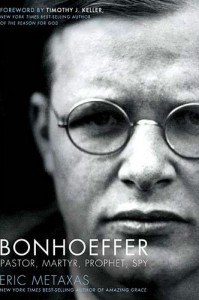 I was introduced to the book during a couple talks [1] [2] by the author, Eric Metaxas. Admittedly, I was a bit intimidated by such a lengthy, historical biography. But his stories and wit captured my interest, and thankfully he did not betray that style while writing the book.
Despite knowing the way Bonhoeffer’s life ended, I found myself eager to continue reading as the story of his life unfolded. This was due in part to the engaging writing of Metaxas, as well as the contagiousness of Bonhoeffer, himself, and the fascinating life he lived. My historical knowledge was enhanced, and my faith was immensely challenged.
From an historical perspective, I confess there were numerous aspects regarding Hitler and his ilk that I had not previously known. So, too, regarding the plots against his life by those determined to put an end to his tyrannical reign. It was sickening how the Nazis were able to use a bastardized version of “Christianity” as propaganda to win over believers in their cause.
Likewise, the helplessness of watching the church (both within Germany and without) struggle to be faithful and uncompromising was saddening, to say the least. I realize such an assessment comes from a safe distance afforded by historical perspective. Bonhoeffer was sickened by the rationalization of some leaders within the church to justify acceptance of, and in some cases support for, the Third Reich. Others within the church believed the church should avoid any involvement. Metaxas summarized Bonhoeffer’s frustration with that view when he wrote,
When the state is trying to encroach upon the church, this is a proper sphere of concern. But for Bonhoeffer, the idea of limiting the church’s actions to this sphere alone was absurd. The church had been instituted by God to exist for the whole world. It was to speak into the world and to be a voice in the world, so it had an obligation to speak out against things that did not affect it directly. (p. 280)
“At the end of the day I can only ask God to give a merciful judgement on today and all its decisions. It is now in his hand.” — Dietrich Bonhoeffer
It’s hard to summarize how fervently Bonhoeffer lived his faith, and strived incessantly to know God more intimately. It wasn’t something he did, it was who he was. Studying Scripture and praying were not religious habits he strived to do on a regular basis, they were a way of life for him. Perhaps the best way to give a sense for Bonhoeffer himself is through his own words. I end with just a few of my favorite Bonhoeffer quotes from the book.
- A Christian community either lives by the intercessory prayers of its members for one another, or the community will be destroyed. I can no longer condemn or hate other Christians for whom I pray, no matter how much trouble they cause me. In intercessory prayer the face that may have been strange and intolerable to me is transformed into the face of one for whom Christ died, the face of a pardoned sinner. That is a blessed discovery for the Christian who is beginning to offer intercessory prayer for others. As far as we are concerned, there is no dislike, no personal tension, no disunity or strife that cannot be overcome by intercessory prayer. Intercessory prayer is the purifying bath into which the individual and the community must enter every day. (p. 90)
- Where a people prays, there is the church, and where the church is, there is never loneliness. (p. 69)
- Do not try to make the bible relevant. Its relevance is axiomatic…. Do not defend God’s Word, but testify to it…. Trust to the Word. (p. 272)
- … extemporaneous preaching can be done by anyone who really knows the Bible. (p. 272)
- Theological work and real pastoral fellowship can only grow in a life which is governed by gathering round the Word morning and evening and by fixed times of prayer. (p. 271)
- I discovered later, and I’m still discovering right up to this moment, that is it only by living completely in this world that one learns to have faith. One must completely abandon any attempt to make something of oneself, whether it be a saint, or a converted sinner, or a churchman (a so-called priestly type!), a righteous man or an unrighteous one, a sick man or a healthy one. By this-worldliness I mean living unreservedly in life’s duties, problems, successes and failures, experiences and perplexities. In so doing we throw ourselves completely into the arms of God, taking seriously, not our own sufferings, but those of God in the world — watching with Christ in Gethsemane. That, I think, is faith; that is metanoia; and that is how one becomes a man and a Christian (cf. Jer. 45!). How can success make us arrogant, or failure lead us astray, when we share in God’s sufferings through a life of this kind? (p. 484)
- Where God tears great gaps we should not try to fill them with human words. They should remain open. Our only comfort is the God of the resurrection, the Father of our Lord Jesus Christ, who also was and is his God. (p. 349)
- It is remarkable how I am never quite clear about the motives for any of my decisions. Is that a sign of confusion or inner dishonesty or is it a sign that we are guided without our knowing or is it both …The reasons one gives for an action to others and to one’s self are certainly inadequate. One can give a reason for everything. In the last resort one acts from a level which remains hidden from us. So one can only ask God to judge us and to forgive us…. At the end of the day I can only ask God to give a merciful judgement on today and all its decisions. It is now in his hand. (p. 336)
Talks By The Author
[1] Eric Metaxas at Family Research Council (October 2010)
[2] Eric Metaxas at Calvin College, January Series (January 9, 2012)

Leave a Reply